
Coloring Guide
Best Paper for Coloring Pages
Choose practical paper for printable coloring pages based on colored pencils, crayons, markers, printer compatibility, and the kind of coloring experience you want.
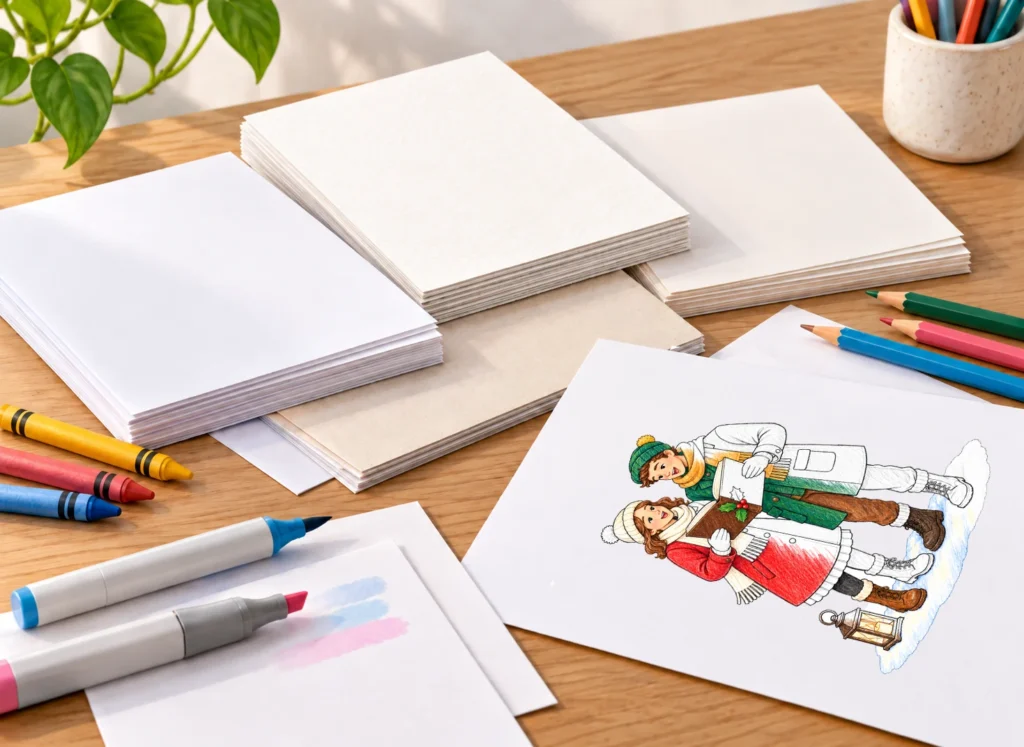
The paper you use can change how a printable coloring page feels and behaves. It affects how pencils build color, how marker ink interacts with the sheet, how sturdy the finished page feels, and whether the paper feeds reliably through your printer.
There is no single paper that is best for every coloring page. A practical choice depends on what you plan to color with, the result you want, how much you need to print, and what your home printer can comfortably handle.
Quick answer
For everyday coloring, ordinary printer paper is often enough. Colored pencils may benefit from a surface that supports layering or fine detail, while markers make bleed-through and absorbency more important. Heavier paper can feel sturdier, but it is not automatically better and may not be supported by every printer.
If you are trying a paper you have not used before, a quick test page can help you see how it works with your printer and coloring tools.
What matters when choosing coloring paper
You do not need to choose paper by weight alone. Several characteristics work together.
Surface texture affects how pencils and crayons move across the page and how easily pigment builds. Absorbency affects how marker ink spreads and penetrates the sheet. Opacity affects how visible printed or colored areas are from the other side, while stiffness changes how substantial the finished page feels.
Paper weight is often shown in gsm, or grams per square meter. A higher gsm usually indicates a more substantial sheet, but the number does not tell you everything about texture, absorbency, stiffness, or how a particular marker will behave.
Printer compatibility matters too. A paper may look perfect for coloring but still be impractical if your printer has trouble feeding it.
Best paper characteristics for colored pencils
Colored pencils can work on many types of paper. A surface with some texture, often called tooth, can help the paper hold pigment and support repeated layers of color. A smoother surface can be useful when you want cleaner edges or very fine details.
Extremely slick paper may offer less grip for layering, while a very rough surface can make small coloring areas harder to control. The right balance depends on how you like to color.
You do not need specialty artist paper for casual pencil coloring. If you enjoy building several layers, blending colors, or spending more time on detailed pages, trying a sturdier drawing paper can be worthwhile, especially if it works comfortably with your printer.
Paper for crayons
Crayons are one of the easiest coloring tools to pair with everyday paper. Ordinary printer paper is often perfectly adequate for casual coloring, children’s activities, and classroom use.
A sturdier sheet can be useful when children press hard, when the page will be displayed, or when you simply prefer a more substantial finished page. That is a practical preference rather than a requirement for using crayons.
Paper for markers: bleed-through changes the choice
Markers make paper choice more important because liquid ink can soak into or through the sheet. The amount of bleed-through depends on the marker, the paper surface, its absorbency, and how much ink is applied—not just on paper weight.
Water-based markers may work well on ordinary or moderately sturdy printer-compatible paper, although heavy application can still cause wrinkling or show-through.
Alcohol-based markers can penetrate many types of paper, so even a heavier sheet may still allow some bleed-through. A scrap sheet underneath the coloring page can help protect your table or the next page. If you are not sure how a particular marker will behave on the paper you are using, try it on a test page or spare sheet first.
Paper designed specifically for markers can behave differently from ordinary cardstock, so a higher gsm number alone is not a guarantee of better marker performance.
Copy paper vs heavier paper
| Copy or printer paper | Heavier paper |
|---|---|
| Usually inexpensive and easy to replace | Usually costs more per sheet |
| Often feeds easily through home printers | Compatibility depends on your printer |
| Works well for everyday crayons and casual pencil coloring | Can feel better for layering, display, or keepsake pages |
| More likely to show through or buckle with wet media | Usually feels sturdier in the hand |
| Practical for classrooms and large batches | A nice option for display, gifts, or pages you want to keep |
Neither option is automatically better. The useful question is whether heavier paper solves a problem you actually have.
Will thicker paper work in my printer?
If you are considering noticeably thicker paper or cardstock, it is worth checking what your printer supports. Different printer models handle paper weight, thickness, and media types differently.
Some printers also handle heavier paper differently depending on where it is loaded. A rear or manual feed path may support media that the main paper tray does not, but this varies by printer.
Do not force cardstock or other heavy paper through a printer that does not list it as supported media. If you are unsure about page size, scaling, or basic print settings, see our guide How to Print Coloring Pages at Home.
Trying a new paper? A test page can help
If you have not used a particular paper with your printer or coloring tools before, printing one test page can help you see how the combination behaves before making multiple copies.
- Choose the paper you want to try.
- Print one coloring page.
- Check that the paper feeds properly and that the printed lines look clean.
- Try the pencils, crayons, or markers you plan to use.
- Look for show-through, bleed-through, curling, smudging, or anything about the surface that affects how you like to color.
- If you are happy with the result, print as many additional copies as you need.
If you already know that your paper, printer, and coloring tools work well together, there is no need to repeat this test. These suggestions are here to help you understand your options, not to create extra steps. You can keep things simple and print in whatever way works best for you.
Paper for kids and classroom coloring
For children, schools, and group activities, the most practical paper is often the one that is affordable, easy to replace, and reliable in the printer.
Premium or heavyweight paper is not automatically better for a classroom activity. If children are coloring with crayons or ordinary colored pencils and many copies are needed, regular printer paper may be the most sensible choice.
Sturdier paper can make sense when the finished work will be displayed, taken home as a keepsake, or colored with materials that benefit from a stronger sheet.
How to choose without overthinking it
Mostly crayons or casual coloring? The printer paper you already use may be all you need.
Mostly colored pencils? A little surface texture can help with layering, while smoother paper may feel better for fine details.
Using markers? Bleed-through and absorbency matter more than paper weight alone. A protective sheet underneath can be useful when needed.
Printing pages to display or keep? A sturdier sheet can give the finished page a more substantial feel.
Printing many copies? Cost, availability, and reliable feeding may matter more than specialty paper.
Final thoughts
You do not need to find one perfect paper before enjoying a printable coloring page. The paper you already have may work perfectly well, and different tools, printers, and coloring styles naturally lead to different preferences.
Use these guidelines when they are helpful, experiment when you feel like it, and keep things as simple as you want. There is no single paper choice you have to get right before you start coloring.
Put the guide into practice
Try These Coloring Pages
From learning to coloring
Ready to Color?
Explore free printable coloring pages for your next creative moment.
Browse All Coloring Pages